The Situation
Steve runs a 4-bay independent garage in Cheshire. The business handles general servicing, repairs, MOTs and diagnostics with an annual turnover of approximately £420,000. Parts spending runs at roughly £95,000 per year — the single largest cost line after wages.
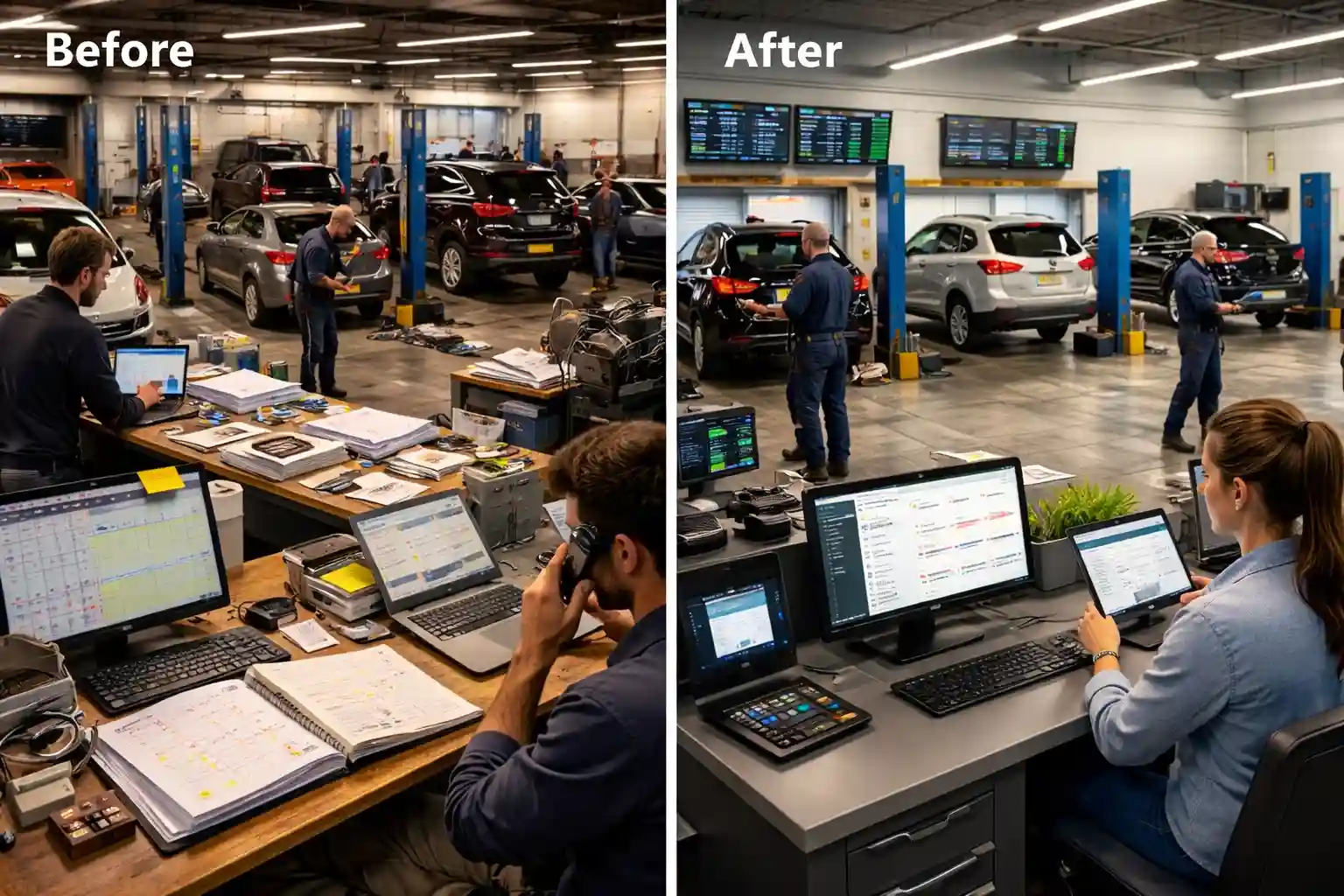
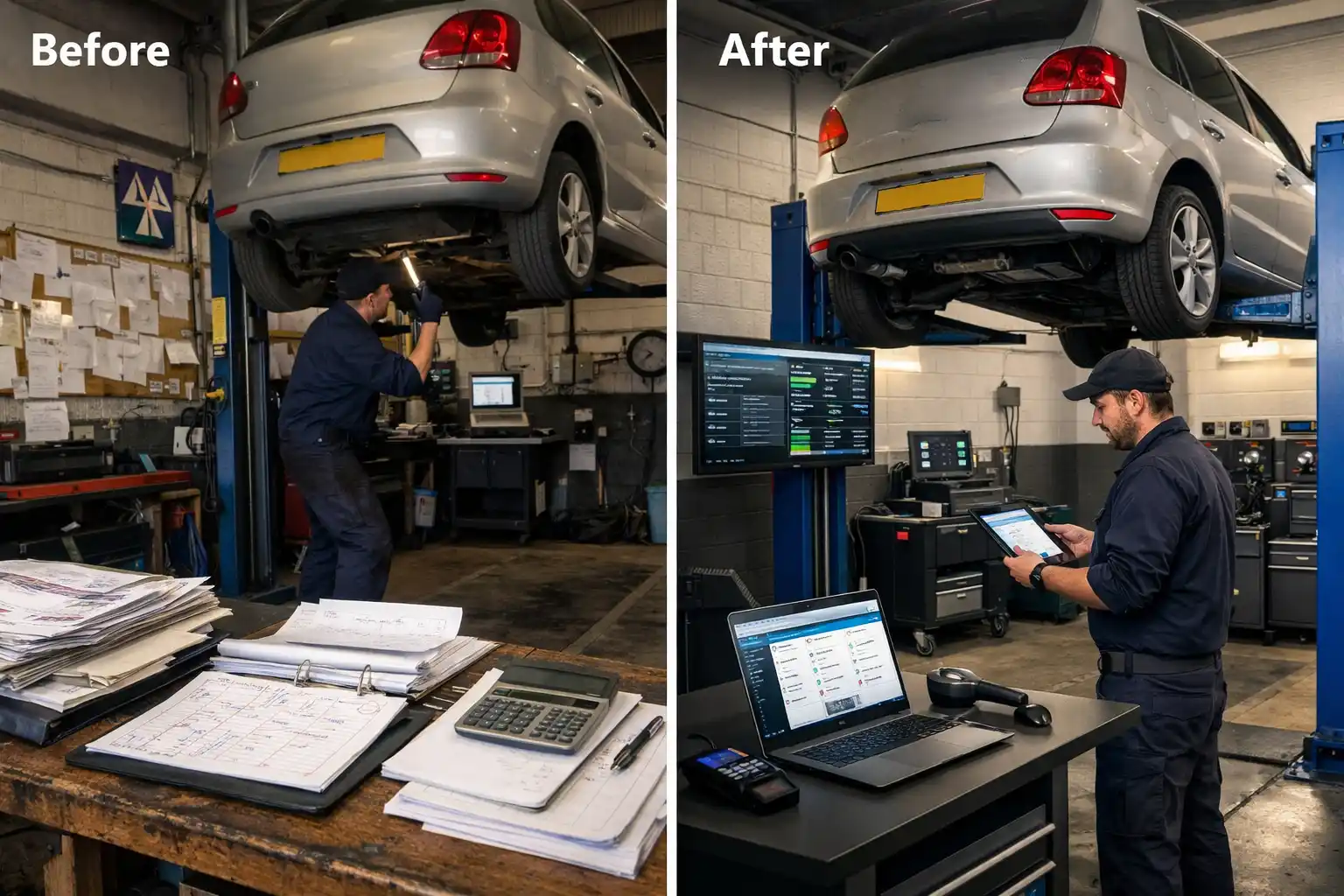
Job cards were handwritten on paper. When a technician needed a part, they either pulled it from the shelf or ordered it from the supplier. The part went on the car. At the end of the job, the receptionist typed up the invoice using the paper job card as the source — manually adding whatever parts the technician had written down.
Anatomy of a Parts Leak
The leak wasn't caused by theft, dishonesty or negligence. It was caused by a broken process — a gap between the shelf and the invoice that no one could see:
Technician pulls a filter from the shelf
Fits it to the car. Writes "oil + filter service" on the paper job card. Doesn't list the filter separately — it's included in the service price in their head.
Mid-job, a worn belt is spotted
Technician calls the customer, gets verbal approval, fits the belt. Writes "belt" on the job card. Doesn't write the part number, price, or supplier. Moves to the next job.
Receptionist types the invoice at 4pm
Reads the handwriting. Invoices the service, the belt labour. The belt part cost? Missed — because the price wasn't on the card and no one checked the purchase order. The filter? Absorbed into the service price without a separate line.
End of month — supplier invoice arrives
Steve pays £7,800 for parts. The garage invoiced £7,100 in parts to customers. The £700 difference? Invisible. Absorbed. Repeated every single month.
The Fix
My Garage CRM connects the shelf to the invoice. When a technician adds a part to a digital job card, that part — with its description, cost price, selling price and supplier — automatically appears on the invoice. It cannot be missed because the invoice is generated from the job card, not typed separately.
- Part added to job card → automatically deducted from stock
- Part on job card → automatically appears on the invoice
- Invoice generated → parts, labour and VAT all pre-populated
- Nothing can be fitted without being billed — the workflow eliminates the gap
Week-by-Week Comparison
Steve tracked the gap between parts purchased and parts invoiced for the first 5 weeks after switching:
| Week | Parts Purchased | Parts Invoiced | Gap |
|---|---|---|---|
| Pre-switch average | £1,830 | £1,010 | -£820 |
| Week 1 | £1,790 | £1,680 | -£110 |
| Week 2 | £1,860 | £1,790 | -£70 |
| Week 3 | £1,920 | £1,860 | -£60 |
| Week 4 | £1,750 | £1,700 | -£50 |
| Week 5 | £1,810 | £1,740 | -£70 |
The weekly gap dropped from £820 to an average of £72 — a 91% reduction. The remaining small gap is accounted for by warranty parts and internal use items (cleaning supplies, consumables) which are legitimately not customer-invoiced.
Before and After
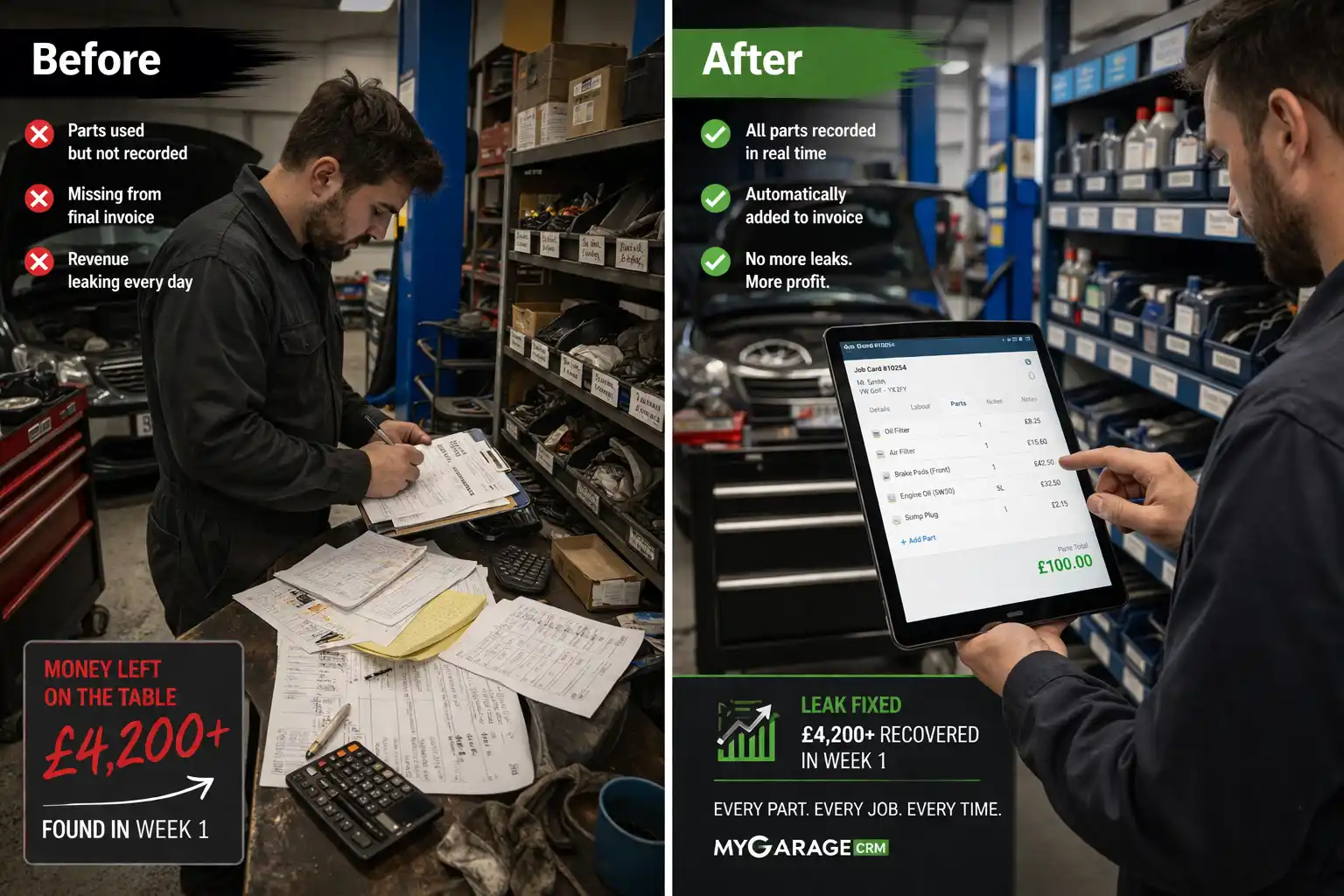
❌ Before
- Paper job cards — parts handwritten
- Invoices typed separately from job cards
- No link between stock and billing
- Parts gap of £820/week — invisible
- No part-level cost tracking per job
- Supplier invoices never reconciled against customer billing
✅ After
- Digital job cards — parts added with price
- Invoice auto-generated from job card
- Parts deduct from stock and appear on invoice simultaneously
- Parts gap reduced to £72/week (warranty + consumables)
- Full cost and margin visible per part, per job
- Parts purchased vs parts invoiced reportable at any time
Results After 90 Days
Revenue recovered
Over 90 days, the garage recovered approximately £4,200 per month in parts that were previously used but unbilled — a total of £12,600 in the first quarter. This is not new work or new customers. It's revenue from work already being done, now being captured.
Margin visibility
For the first time, Steve can see the parts margin on every job. The reporting dashboard shows cost price, selling price and margin per part line. In the first month, he identified three commonly used parts where the markup was below target and adjusted pricing accordingly.
Stock accuracy
Because parts are now deducted from stock when added to a job card, the stock count in the system matches the shelf. Low-stock alerts fire before parts run out — not after a job is delayed because someone used the last filter without telling anyone.
Technician behaviour
Technicians adapted to adding parts on the digital job card within two days. The process is actually faster than writing on paper because the parts catalogue auto-suggests items and pre-fills prices. No resistance, no training issues.
Key Takeaways
- Every garage with paper job cards has this leak. If the path from shelf to invoice has a manual step, parts are being missed. The only question is how many.
- The leak is invisible until you connect stock to billing. You can't see the gap by looking at invoices alone — you need to compare parts purchased against parts invoiced. Most garages have never done this.
- The fix isn't about discipline — it's about process. Asking technicians to write more carefully doesn't work. Connecting the job card to the invoice so parts can't be missed does.
- ROI is measured in days. A £139/month subscription recovered £840 in the first week. The payback period was less than 48 hours.
- The recovered revenue is pure profit. The parts were already purchased and the labour was already done. The only thing missing was the invoice line. Recovering it costs nothing.