
The Situation
Ian owns three independent workshops across Yorkshire — one in Leeds, one in Wakefield and one in Huddersfield. The group turns over approximately £1.2 million a year across general servicing, repairs, MOTs and diagnostics. He employs 11 technicians, 3 receptionists and an operations manager who travels between sites.
Each workshop had grown independently and each had ended up on a different system. Leeds used an older desktop-based garage package. Wakefield ran on spreadsheets and paper. Huddersfield used a basic cloud invoicing tool. No customer data was shared between locations.
The Problem
Running three workshops on three different systems created problems that compounded as the group grew:
- No shared customer records — a customer who used the Leeds site was invisible to Wakefield and Huddersfield. If they moved house or changed employer, they were treated as a new customer at the nearest branch.
- No consolidated reporting — revenue, outstanding invoices and job throughput were tracked separately at each site. Group-level performance required manual extraction and a spreadsheet every month.
- Inconsistent processes — each site followed different workflows for bookings, job cards and invoicing. Staff moving between sites had to relearn different systems.
- No cross-site visibility — if one site was fully booked and another had spare capacity, there was no way to redirect work without phone calls and guesswork.
- Duplicate costs — three separate software subscriptions, three separate SMS providers, three separate payment processors. Admin overhead scaled with every site added.
The Three Sites
Leeds
Desktop garage software
~1,200 active customers
Wakefield
Spreadsheets + paper
~900 active customers
Huddersfield
Cloud invoicing tool
~700 active customers
The Migration
The migration was phased — one site per week over three weeks. Wakefield went first because it had the simplest existing system (spreadsheets), making it the lowest-risk starting point. Huddersfield followed in week two, and Leeds completed in week three.
Week 1 — Wakefield
900 customer records imported from spreadsheets. Digital diary replaced the paper booking system. Staff trained on bookings, job cards and invoicing in a single morning session. Live by Monday afternoon.
Week 2 — Huddersfield
700 customer records imported from the invoicing tool's export. Existing invoice history preserved for reference. MOT dates pulled from a separate reminder list and attached to vehicle records. Staff trained and live within two days.
Week 3 — Leeds
1,200 customer records migrated from the desktop package — the most complex import due to legacy data formats. Vehicle histories, MOT records and outstanding invoices all transferred. De-duplication identified 180 customers who appeared at more than one site — these were merged into single shared records.
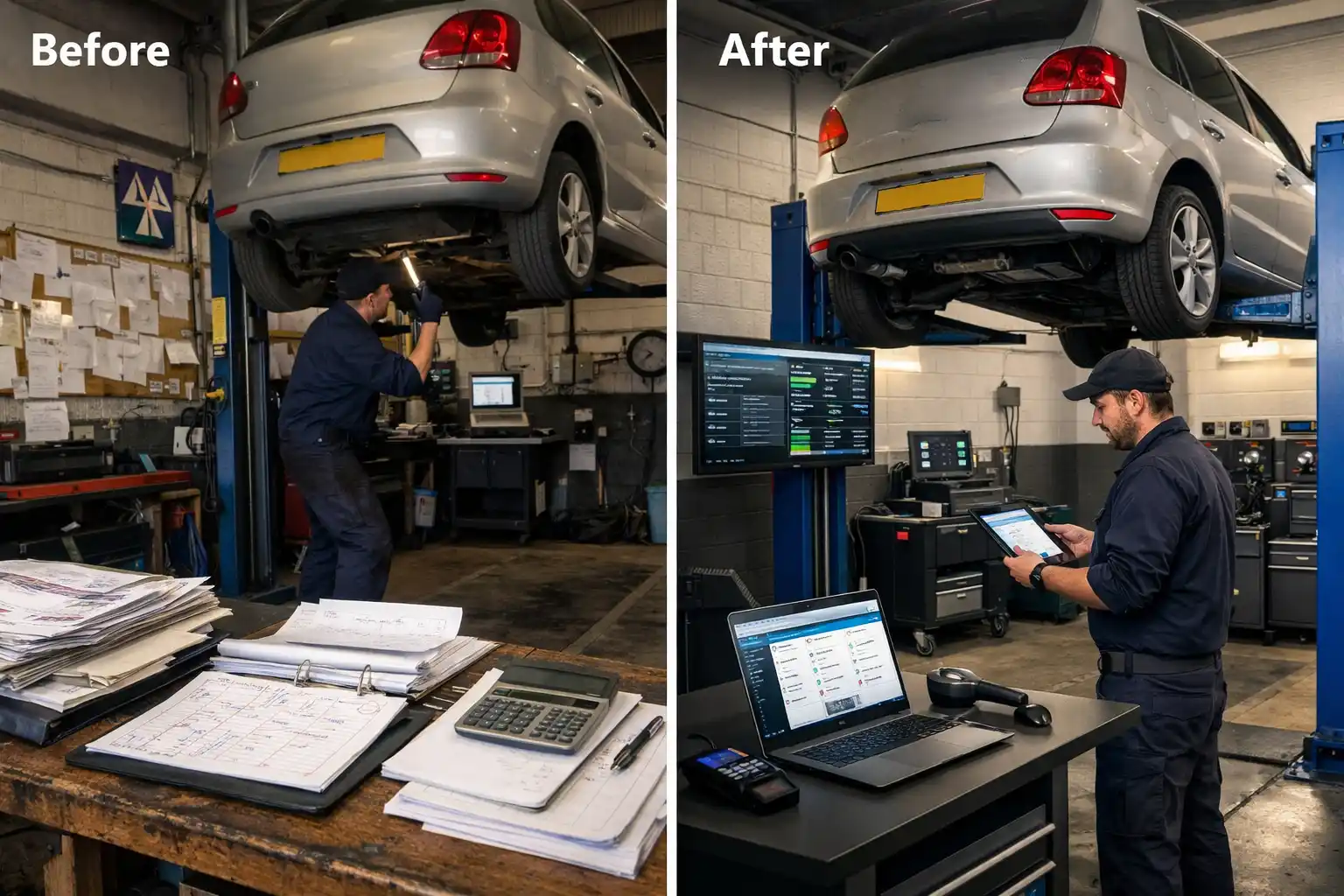
Before and After
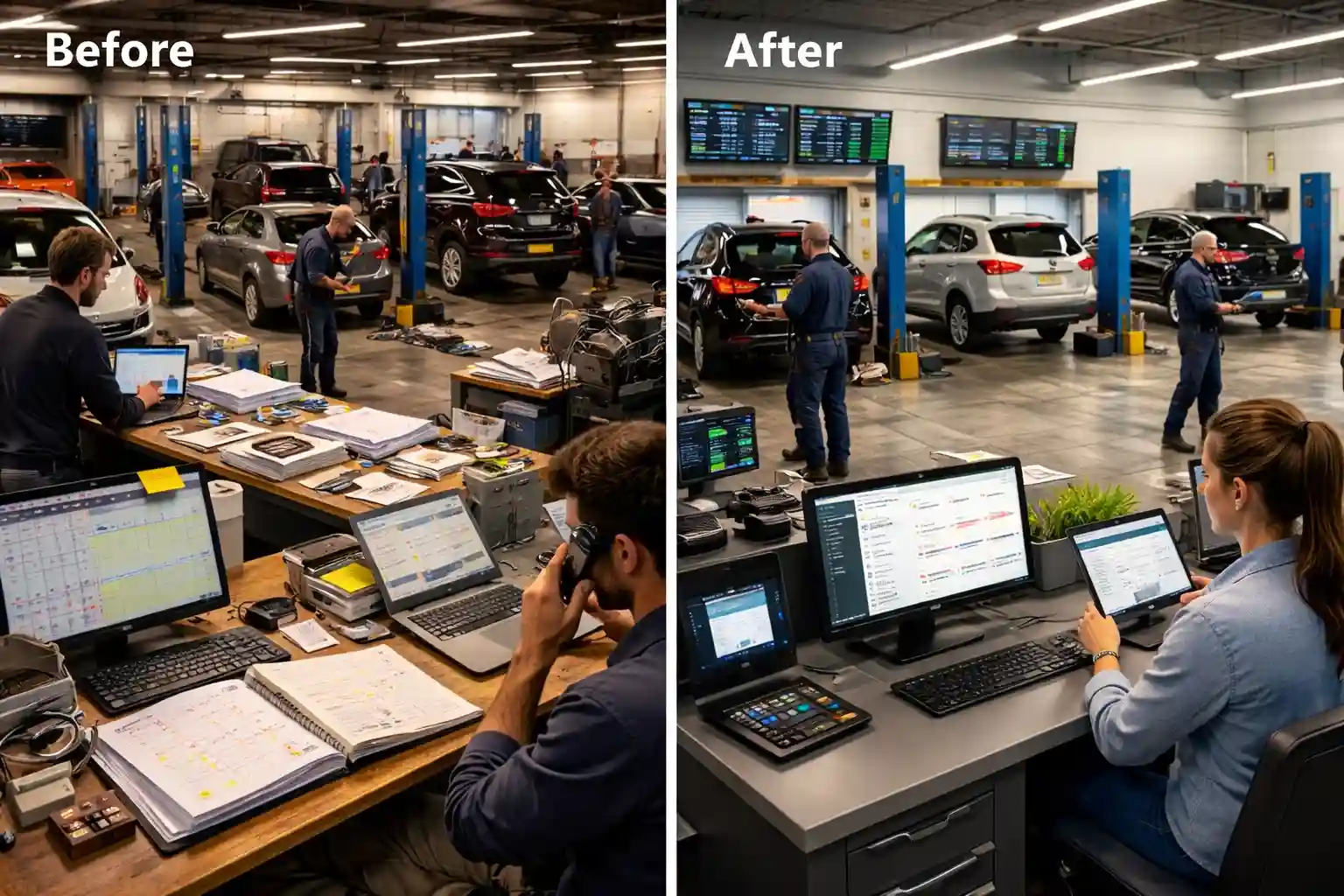
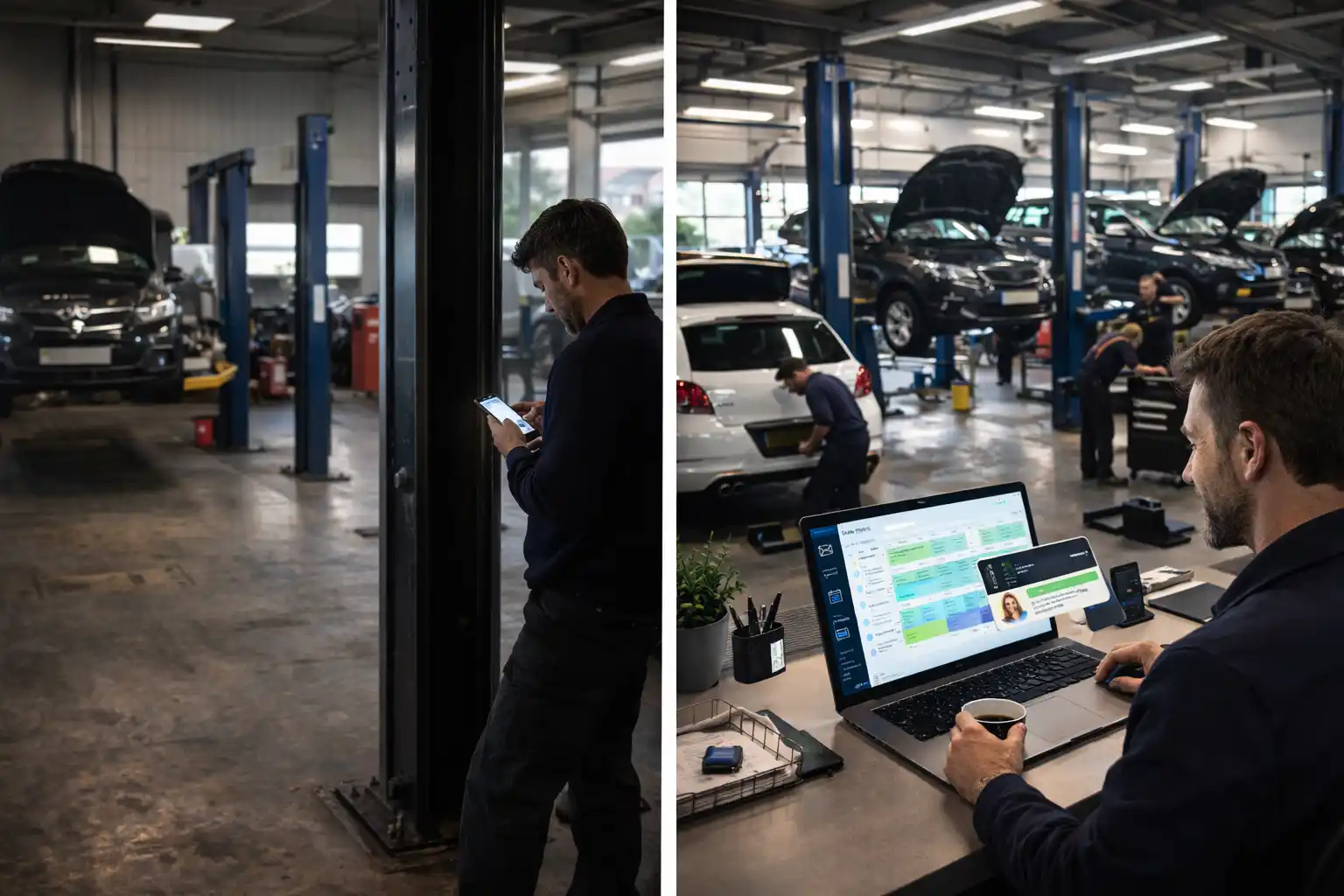
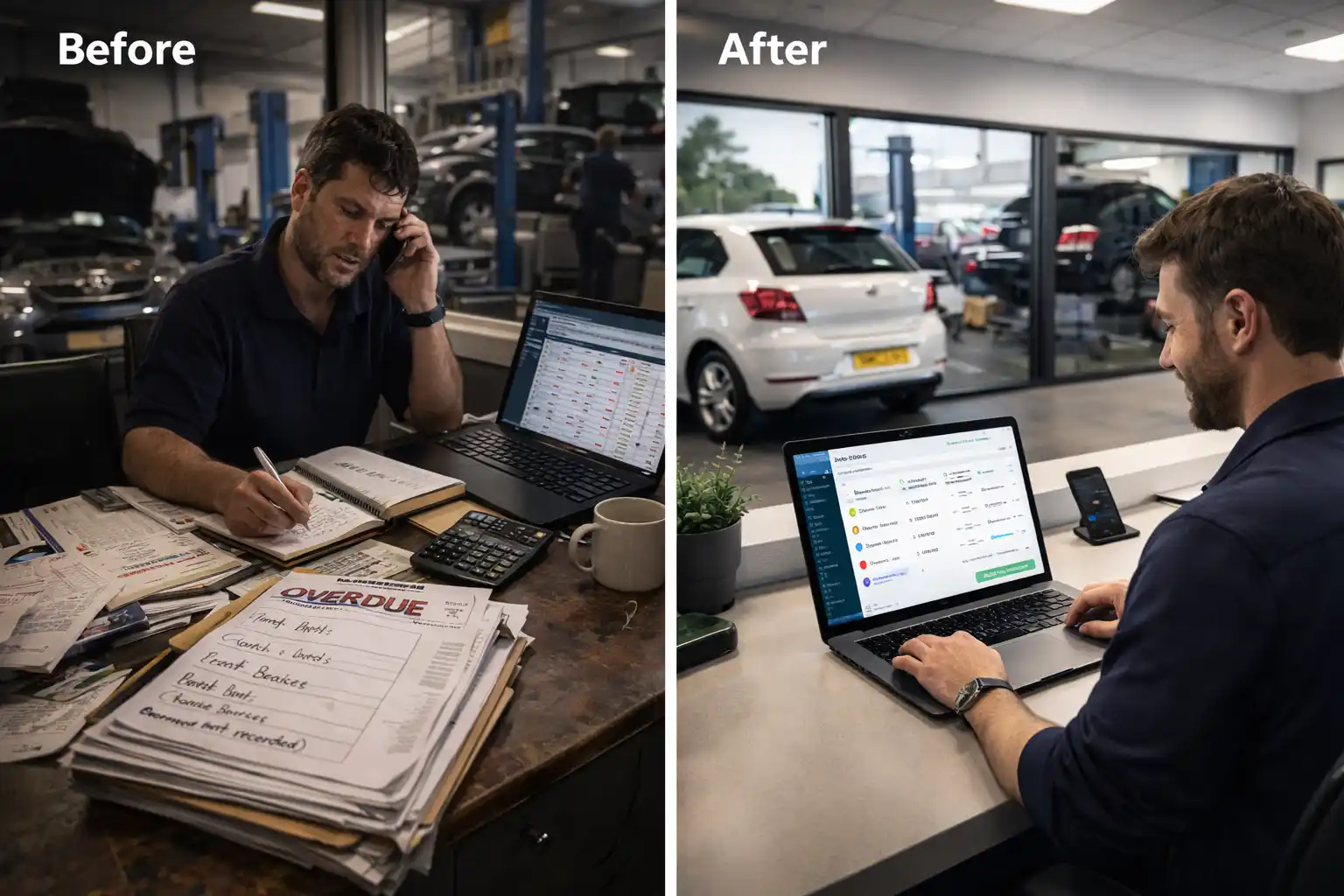
❌ Before
- 3 different software systems
- No shared customer data between sites
- Monthly group report took half a day to compile
- 180 duplicate customer records undetected
- No cross-site diary visibility
- Staff had to relearn systems when moving sites
- 3 separate SMS providers and payment processors
✅ After
- 1 system across all 3 sites
- 2,800 shared customer records — one profile per customer
- Group dashboard updates in real time
- Duplicates merged — clean, accurate data
- Cross-site diary visible from any location
- Identical workflow at every site — staff move freely
- 1 SMS provider, 1 payment processor, 1 subscription
Results After 90 Days
Consolidated reporting
Ian now opens one dashboard and sees revenue, outstanding invoices, job count, technician utilisation and MOT conversion across all three sites — updated live. The monthly report that previously took half a day to compile manually now takes zero time. It's always there.
Cross-site customer experience
Customers are now recognised at any location. A customer who normally uses Leeds but books into Wakefield for convenience sees their full vehicle history, service records and preferences pulled up instantly. No re-registration, no lost context.
Workload balancing
When the Leeds diary is full, the receptionist can see available slots at Wakefield and Huddersfield and offer the customer an alternative. In the first 90 days, 47 bookings were redirected between sites that would previously have been lost entirely or delayed.
Admin reduction
Consolidating three SMS providers, three payment processors and three separate reporting workflows into one system saved approximately 5 hours of admin time per week across the operations manager and three receptionists. That's over 260 hours per year returned to productive work.
Cost savings
Three separate software subscriptions were replaced by one Enterprise plan at £199/month. Combined with the reduction in duplicate SMS provider costs and payment processing fees, the group saves approximately £180/month in direct software costs alone — before accounting for the admin time savings.
Key Takeaways
- Multi-site groups lose the most from disconnected systems. The problems aren't just inconvenience — they're duplicate costs, lost customers and invisible inefficiencies that scale with every site added.
- Phased migration reduces risk. Starting with the simplest site, proving the workflow, then rolling out to more complex locations over three weeks avoided disruption to any single workshop.
- Customer deduplication is immediate value. 180 duplicate records meant 180 customers getting a worse experience. Merging them into single profiles improved communication accuracy overnight.
- Cross-site diary visibility captures lost bookings. 47 bookings redirected between sites in 90 days — work that would have been turned away or delayed without shared visibility.
- The Enterprise plan pays for itself in cost reduction alone. Before counting productivity gains, the direct software cost savings from consolidation exceeded the subscription price.